Municipalities are modernising public spaces
urban furniture management, municipal council software, urban furniture inventory, municipal georeferencing, public space management, citizen participation, smart cities, fault management, municipal platform
Urban furniture management: how municipalities are modernising public spaces
Park benches, litter bins, recycling points, traffic lights, street lamps, trees, playgrounds, outdoor fitness equipment. Urban furniture is the part of the city that residents interact with every day — and, for that very reason, it is also one of the hardest to manage. How many benches exist across the municipality? Where are they? How many need repair right now? For many local councils, answering these questions still means cross-referencing scattered spreadsheets, paper maps and the memory of field teams.
This is the reality that Inventário Urbano is built to change: an urban furniture management platform designed from the ground up for local councils, bringing inventory, georeferencing, maintenance and citizen communication together in one place.
The problem: managing what you don't know
You cannot manage what you don't know. Without an accurate, up-to-date inventory of public spaces, municipal services are working in the dark: interventions are reactive rather than planned, costs are hard to control, and reporting to residents becomes an exercise in estimation.
The symptoms will be familiar to any local authority manager. Complaints lost between departments. Faulty equipment only fixed after repeated phone calls. No reliable data to support investment decisions or funding applications. And a persistent difficulty in demonstrating, with hard numbers, the work that services actually do.
Digitalising public space management is no longer a luxury — it is an efficiency imperative and, increasingly, something citizens simply expect.
The solution: a georeferenced inventory, accessible to everyone
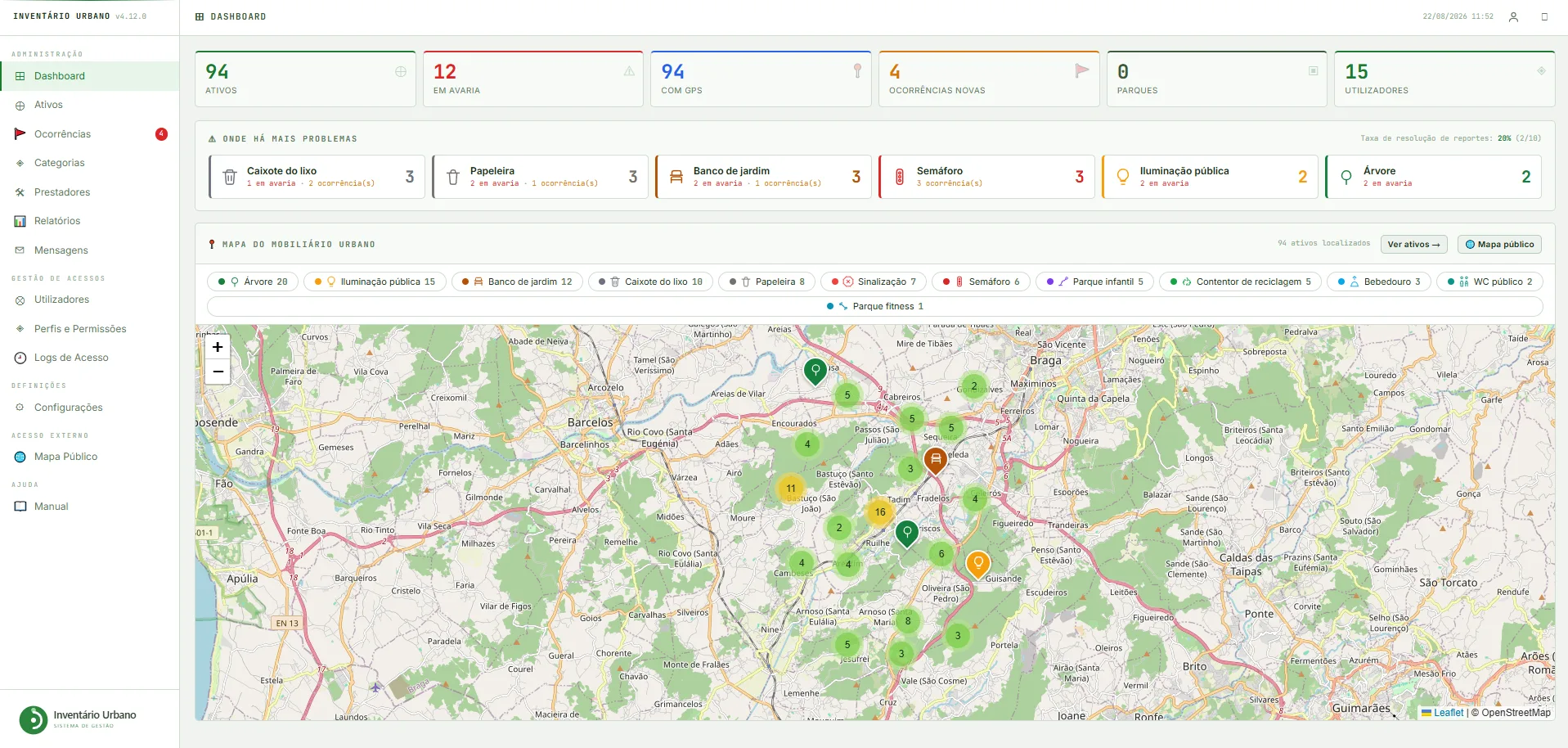
The first step is knowing what you have. With Inventário Urbano, every urban furniture asset gets a complete digital record and a precise location on the map. Asset categories are defined by the council itself — and, crucially, with unlimited custom fields: material, installation date, capacity, supplier, warranty, or any other attribute relevant to each type of equipment.
This flexibility is essential. A litter bin is not described in the same way as a street lamp or a tree, and the platform adapts to that diversity without forcing the municipality to fit its reality into a rigid form. Assets can also be organised in a hierarchy — for example, the various pieces of equipment within a single playground — and are automatically linked to their respective parish, detected via GPS.
The result is a living, searchable and always up-to-date register, accessible from any computer or mobile device.
From fault to fix: maintenance under control
Knowing the inventory is the foundation; managing it is the goal. From each asset record, teams log faults, inspections and repairs, with cost tracking and an automatic status cycle: when a fault is opened, the asset is flagged; when the repair is completed, it returns to operational. Nothing gets lost, everything is documented.
Interventions can be routed to internal teams or to external contractors, assigned by default to each asset category. This means a lighting fault is automatically directed to the right person, with no emails back and forth or phone calls needed. For fieldwork, a field mode optimised for mobile devices allows teams to locate nearby assets and log occurrences on the spot, without returning to the office.
This is the heart of efficient fault management: less time lost on coordination, more time spent on resolution.
Citizens as partners: participation that closes the loop
The best-run cities are those where residents play an active part. Inventário Urbano includes a public map, accessible without registration, where residents can see urban furniture and already-reported issues. Anyone can report an occurrence in seconds — anonymously or by leaving contact details — by pinning the location on the map or scanning the QR code attached to the asset itself.
Each report generates a tracking code, allowing the citizen to follow the resolution of their issue without relying on phone calls or front desks. On the council's side, reports arrive organised, are managed through status stages and can be converted directly into internal faults with a single click. This is citizen participation working in practice: more transparency for those who report, less manual work for those who manage.
This channel transforms the relationship between the municipality and its residents. Instead of scattered, frustrating complaints, a structured flow is created where every problem has an owner, a status and an outcome.
Decisions backed by data: reports that tell the right story
One of the greatest benefits of digitalising public space management is the ability to make decisions based on data. The platform generates inventory reports by period, with indicators, charts and breakdowns by category and parish, as well as full detail on occurrences and maintenance.
These reports can be viewed on screen, sent by email or exported as a professional PDF document, complete with the municipality's logo and visual identity — ready to present at a council meeting, include in an activity report or support a funding application. For the first time, services can show, with numbers and maps, the work they carry out and the results they achieve.
A concrete step towards smart cities
There is a lot of talk about smart cities, but a city's intelligence starts with something simple: reliable data about its territory and processes that actually work. A massive investment in sensors is not required to make a real efficiency leap — what is needed, first and foremost, is knowing what you have and organising the way you manage it.
Inventário Urbano positions itself exactly there: as the georeferenced database and process engine on which a municipality can build its modernisation strategy, at its own pace and on its own terms. Designed for dedicated installation per municipality, it ensures that each council's data remains isolated and under its control, with custom visual branding, role-based user management and automatic backups.
Start getting to know your public space today
Modernising urban furniture management does not have to be a complex or lengthy project. With Inventário Urbano, your municipality can start inventorying, managing and communicating more efficiently — and involve citizens in the ongoing improvement of a space that belongs to everyone.
Request a demo and discover how your council can better know, manage and care for its public spaces, with the involvement of the people who use them every day.

The ID Digital team, a web design and digital marketing agency in Aveiro, with over 10 years of experience in digital projects.